
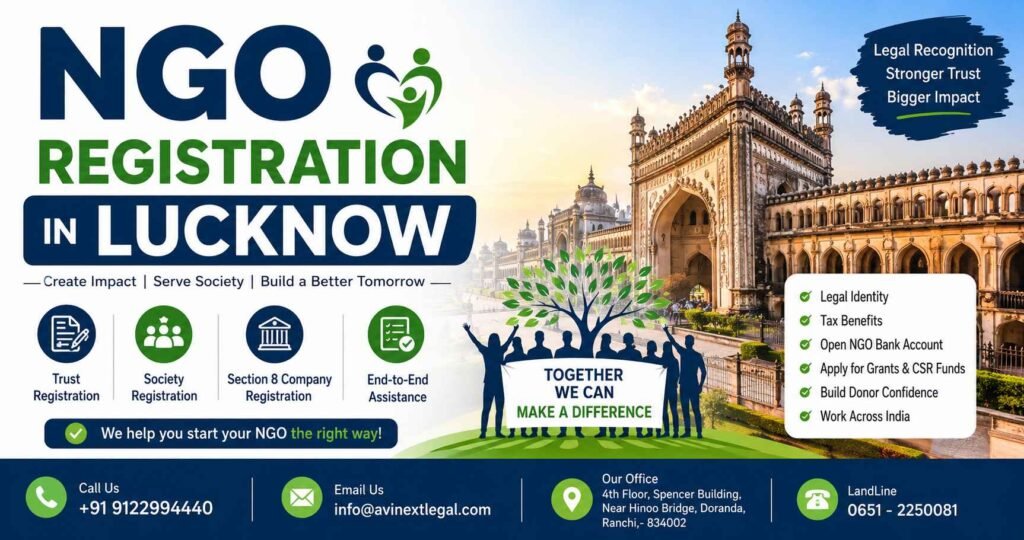
NGO Registration in Lucknow 2026: Starting an NGO in Lucknow can be an effective way to work systematically in areas such as education, healthcare, women empowerment, child welfare, rural development, environmental protection, skill development, poverty relief, animal welfare, social awareness, and other charitable activities.
However, many people who want to start an NGO are unsure about the legal structure they should choose, the documents required, the registration cost, and the compliance requirements after registration.
In India, “NGO” is not a separate legal structure by itself. An organisation intending to operate on a non-profit basis is generally established as a Trust, Society, or Section 8 Company. The right structure depends on the organisation’s objectives, number of members, geographical scope, funding plans, governance requirements, and long-term vision.
If you are planning NGO Registration in Lucknow in 2026, this detailed guide explains the available registration options, eligibility criteria, documents required, estimated costs, registration procedure, and important post-registration requirements.
What is an NGO?
NGO stands for Non-Governmental Organisation. It generally refers to an organisation established to work for charitable, social, educational, religious, environmental, developmental, or other public-benefit purposes rather than for distributing profits among its members.
An NGO may work in one or several areas, including:
- Education and literacy
- Healthcare and medical assistance
- Women empowerment
- Child welfare
- Skill development
- Rural development
- Poverty alleviation
- Environmental protection
- Animal welfare
- Social awareness
- Sports promotion
- Art and culture
- Research
- Community development
- Support for senior citizens
- Support for persons with disabilities
- Disaster relief and rehabilitation
- Other lawful charitable and social-development activities
The organisation’s actual objects should be clearly defined at the registration stage because they become an important part of its constitutional documents.
Types of NGO Registration in Lucknow
An NGO in Lucknow can generally be registered under one of three structures:
- Trust
- Society
- Section 8 Company
Each structure has different legal, administrative, and compliance characteristics.
1. Trust Registration in Lucknow
A charitable trust is generally established through a Trust Deed, which defines the objectives of the trust, powers and responsibilities of trustees, management structure, use of funds, and other operational rules.
A Trust can be suitable where the organisation wants a relatively straightforward governance structure with clearly identified trustees.
Trusts are commonly used for activities connected with:
- Education
- Healthcare
- Religious or charitable work
- Poverty relief
- Community welfare
- Public charitable activities
The applicable stamp duty and registration-related expenses can depend on the nature and wording of the deed and the applicable Uttar Pradesh stamp and registration rules. Therefore, applicants should verify the applicable government charges at the time of execution instead of relying on a fixed online estimate.
The Uttar Pradesh Stamp and Registration Department provides an official stamp and registration fee calculator for applicable documents.
2. Society Registration in Lucknow
A Society is another widely used structure for NGOs, particularly where several individuals want to collectively manage an organisation.
Societies are generally registered under the Societies Registration Act, 1860, as applicable in Uttar Pradesh along with relevant state amendments and rules.
A Society is commonly suitable for organisations involved in:
- Education
- Social welfare
- Cultural activities
- Charitable programmes
- Sports
- Research
- Community development
- Public awareness
- Rural development
- Environmental initiatives
For a Society, the organisation normally prepares a Memorandum of Association (MOA) and Rules & Regulations describing its objects, membership structure, governing body, meetings, decision-making process, financial administration, and other governance matters.
The Registrar, Firms, Societies and Chits, Uttar Pradesh handles society registration in the state.
As reflected on the Uttar Pradesh Registrar’s official portal in 2026, recent society-registration records show a registration fee of ₹2,000. Applicants should nevertheless verify the fee displayed on the official portal when filing because government fees and procedural requirements may be revised.
3. Section 8 Company Registration in Lucknow
A Section 8 Company is incorporated under the Companies Act, 2013 and is regulated by the Ministry of Corporate Affairs (MCA).
Section 8 Companies can be established for objectives relating to areas such as:
- Commerce
- Art
- Science
- Sports
- Education
- Research
- Social welfare
- Religion
- Charity
- Environmental protection
- Other similar public-benefit objectives
Unlike an ordinary commercial company, a Section 8 Company is formed for promoting its stated non-profit objectives. Its income and profits are intended to be applied towards those objectives rather than distributed as dividends to members.
For organisations seeking a structured governance model, institutional credibility, wider geographical operations, CSR opportunities, or organised fundraising, a Section 8 Company may be worth considering.
The Ministry of Corporate Affairs confirms that the licence for a new Section 8 Company is processed through the SPICe+ incorporation framework. A separate INC-12 filing is not required for obtaining the licence of a newly incorporated Section 8 Company.
Trust vs Society vs Section 8 Company – Which One Should You Choose?
There is no single structure that is best for every NGO.
Choose a Trust when:
You want a trustee-based structure and your activities are primarily charitable, educational, religious, healthcare-related, or community-focused.
Choose a Society when:
You have a group of individuals who want to collectively operate and manage the organisation through a governing body.
Choose a Section 8 Company when:
You want a more formally structured organisation under the Companies Act with defined directors/members and MCA-based corporate compliance.
For organisations planning significant institutional fundraising, CSR partnerships, multi-state expansion, or long-term professional operations, a Section 8 Company may often provide a more structured framework. However, it also comes with more formal compliance responsibilities.
The choice should therefore be based on the organisation’s actual objectives and operating model—not simply on which registration appears cheaper.
Eligibility for NGO Registration in Lucknow
Eligibility depends on the legal structure selected.
However, some basic requirements are common.
Lawful Non-Profit Objective
The proposed organisation should have clearly defined and lawful objectives.
The objects should primarily relate to charitable, social, educational, developmental, environmental, cultural, religious, scientific, or other permissible non-profit purposes.
Members or Trustees
The required number and role of founders will depend on whether the organisation is being established as a Trust, Society, or Section 8 Company.
For example, a Society is ordinarily formed by seven or more persons subscribing to its memorandum under the Societies Registration Act framework.
A private-form Section 8 Company generally requires at least two members and two directors, subject to applicable company-law requirements.
Registered Office
The NGO should have an address that can be used as its registered office.
The office does not necessarily have to be owned by the NGO. Depending on the structure and applicable registration requirements, rented or otherwise lawfully permitted premises may also be used with appropriate supporting documentation and an owner’s NOC where required.
Genuine Documentation
Identity, address, office, and organisational documents submitted for registration should be genuine, current, and consistent.
Mismatch in names, addresses, signatures, or other particulars can cause queries or delays during registration.
Documents Required for NGO Registration in Lucknow
The exact documents vary depending on the type of NGO.
Basic Documents of Members/Trustees/Directors
Generally, the following may be required:
- PAN Card
- Aadhaar Card or other accepted identity proof
- Address proof
- Passport-size photograph, where applicable
- Email ID
- Mobile number
- Details of occupation
- Digital Signature Certificate (DSC), where required for Section 8 incorporation
Additional documents may be required depending on the structure and individual circumstances.
Registered Office Documents
For the proposed registered office, documents may include:
- Recent electricity bill or other accepted utility proof
- Ownership document, where applicable
- Rent agreement, if the premises are rented
- No Objection Certificate (NOC) from the owner, where required
- Complete address and supporting premises documentation
The documentation should clearly establish the right of the organisation to use the address.
Documents Required for Society Registration in Lucknow
Depending on the application and applicable portal requirements, documents and information generally include:
- Proposed name of the Society
- Memorandum of Association
- Rules and Regulations / Bye-laws
- Details of founding members
- Details of governing body members
- Identity and address proofs
- Registered office proof
- NOC from property owner, where applicable
- Prescribed declarations and affidavits, where required
- Other supporting documents requested by the Registrar
The MOA and Rules & Regulations should be drafted carefully because these documents determine how the Society will function after registration.
Documents Required for Trust Registration
For establishing a charitable Trust, commonly required information and documents may include:
- Proposed Trust name
- Details of settlor/author
- Details of trustees
- Identity proofs
- Address proofs
- Registered office/address proof
- Trust Deed
- Objects of the Trust
- Trustee powers and responsibilities
- Property or corpus-related details, where applicable
- Witness details
- Photographs and other supporting documents, where required
The Trust Deed is one of the most important documents. A poorly drafted deed can create problems later while opening bank accounts, changing trustees, obtaining tax registrations, managing property, or applying for grants and approvals.
Documents Required for Section 8 Company Registration
A Section 8 Company registration generally involves documents and information such as:
- PAN and identity proof of proposed directors/subscribers
- Address proof
- Email IDs and mobile numbers
- Registered office proof
- Owner’s NOC, where applicable
- Digital Signature Certificates
- Proposed company names
- Main objects of the proposed organisation
- Memorandum of Association
- Articles of Association
- Prescribed declarations
- SPICe+ and linked incorporation forms
- Other documents required by MCA depending on the application
The proposed name and objects must be carefully drafted because Section 8 status is linked directly to the organisation’s non-profit objectives.
NGO Registration Process in Lucknow – Step by Step
Step 1: Decide Your NGO Structure
The first decision is whether to establish a:
Trust, Society, or Section 8 Company.
Do not make this decision solely on registration cost. Consider governance, future funding, number of members, operational area, compliance capacity, and long-term plans.
Step 2: Finalise the NGO Name
Select a distinctive and legally acceptable name.
Avoid names that are misleading, prohibited, identical or confusingly similar to existing organisations, or suggest government patronage without authority.
For Section 8 Companies, MCA naming requirements also apply.
Step 3: Define the Objects
Prepare a clear list of the organisation’s objectives.
For example, if the NGO plans to work in education, women empowerment, healthcare, rural development, and skill development, these should be appropriately reflected in its objects.
Overly vague or contradictory objects should be avoided.
Step 4: Prepare Constitutional Documents
Depending on the structure, this could include:
- Trust Deed
- Memorandum of Association
- Rules and Regulations
- Memorandum and Articles of Association
These documents define how the organisation will operate.
Step 5: Prepare KYC and Office Documents
Collect identity proofs, address proofs, photographs where required, office proof, NOC, and other supporting documentation.
Step 6: File the Registration Application
The application is filed with the relevant authority depending on the selected structure.
For a Society in Uttar Pradesh, the relevant authority is the Registrar, Firms, Societies and Chits, Uttar Pradesh.
For a Section 8 Company, incorporation is processed through the Ministry of Corporate Affairs (MCA).
Trust registration involves the applicable state registration/stamp framework based on the Trust Deed and circumstances.
Step 7: Respond to Departmental Queries
The authority may seek clarification or correction if there is any issue relating to the proposed name, objects, office proof, member details, constitutional documents, or supporting papers.
A prompt and accurate response can prevent unnecessary delay.
Step 8: Obtain Registration Certificate
After the application is accepted and approved, the organisation receives the applicable registration/incorporation certificate.
The Uttar Pradesh Registrar’s official FAQ states that a Society/Firm registration certificate may be issued within a maximum of 30 days where all submitted documents are found correct. Actual processing time can vary depending on the application and departmental scrutiny.
NGO Registration Cost in Lucknow in 2026
The total cost of NGO registration should be divided into two categories:
1. Government Fees
These depend on the structure selected.
For Uttar Pradesh Society registration, the official state portal’s 2026 registration records currently reflect a ₹2,000 registration fee.
Trust-related stamp duty and registration expenses can vary depending on the Trust Deed and applicable stamp and registration requirements.
For a Section 8 Company, government charges can depend on factors such as the incorporation structure, forms, stamp duty, and other applicable MCA-related charges.
2. Professional Fees
Professional charges depend on the scope of work, which may include:
- Consultation
- Name selection
- Object drafting
- MOA drafting
- Rules and Regulations
- Trust Deed drafting
- Section 8 documentation
- Application preparation
- Filing assistance
- Query handling
- Post-registration assistance
Therefore, advertisements claiming one fixed “all-inclusive NGO registration price” should be examined carefully to understand exactly what is included.
Is NGO Registration Enough to Receive Donations?
Not necessarily.
Registration creates the legal organisation, but additional registrations may be relevant depending on how the NGO intends to operate and raise funds.
These may include:
- PAN
- Bank Account
- Income-tax charitable registration/approval
- Donation-related tax approval
- NGO Darpan registration
- CSR-1 registration, where eligible and required
- FCRA registration or prior permission for eligible foreign contributions
- Other licences or registrations depending on activities
An NGO should apply only for registrations relevant to its actual stage, activities, and eligibility.
Important Income-Tax Changes for NGOs in 2026
NGOs should be particularly careful with older online articles because the income-tax framework has undergone changes.
From 1 April 2026, the Income-tax Act, 2025 framework has become relevant for current compliance. The Income Tax Department’s 2026 guidance explains the transition of existing and pending charitable-organisation registrations and approvals.
For certain non-profit organisations, the Income Tax Department now provides electronic processes under the new framework for regular registration and donation-related approvals.
Accordingly, organisations registering in 2026 should avoid blindly following older guides that refer only to previous forms and provisions without considering the applicable transition rules.
Professional advice should be taken based on the NGO’s date of incorporation, commencement of activities, existing approvals, income level, and registration status.
Can an NGO Apply for 80G-Type Donation Benefits?
Subject to applicable income-tax provisions and approval, eligible charitable organisations may obtain donation-related tax approval so qualifying donors can claim deductions.
Historically, Section 80G has been one of the most commonly recognised tax-benefit provisions for charitable donations. Under the 2026 income-tax framework, organisations should follow the applicable new provisions, forms, and transition rules rather than relying solely on terminology used in older articles.
Approval is not automatic merely because an NGO has been registered.
The tax authority can examine matters such as the organisation’s objects, activities, accounts, constitutional documents, and compliance history.
NGO Darpan Registration
NGO Darpan is an important registration/profile platform associated with NITI Aayog for voluntary organisations.
NGOs intending to interact with government departments, access certain government grants or schemes, or establish an institutional profile may need or benefit from NGO Darpan registration depending on the applicable programme.
NGO Darpan registration should therefore be evaluated as part of the NGO’s post-registration roadmap.
CSR-1 Registration
NGOs intending to act as implementing agencies for eligible Corporate Social Responsibility projects should examine the requirements applicable to CSR-1 registration.
Simply incorporating a Trust, Society, or Section 8 Company does not automatically make it eligible to receive every type of CSR funding.
Eligibility conditions, tax registrations, track record requirements, and other provisions under the Companies Act and CSR Rules may apply depending on the organisation.
FCRA Registration for Foreign Donations
An NGO cannot assume that ordinary NGO registration automatically permits unrestricted receipt of foreign contributions.
Foreign contributions are regulated under the Foreign Contribution (Regulation) Act (FCRA).
Depending on eligibility and circumstances, an organisation may need FCRA registration or prior permission before receiving qualifying foreign contributions.
Receiving foreign funds without understanding the applicable FCRA requirements can create serious compliance issues.
Common Mistakes While Registering an NGO
Several registration problems can be prevented at the planning stage.
Common mistakes include:
Choosing the Wrong Legal Structure
Registering a Trust simply because it appears easier may not be appropriate if the organisation ultimately wants a broader membership-based structure.
Similarly, choosing a Section 8 Company without understanding annual compliance requirements may create unnecessary administrative burden.
Poorly Drafted Objects
The objects clause determines what the organisation is legally established to do. It should be drafted with both present and reasonably foreseeable activities in mind.
Incomplete Office Documents
An unclear NOC, old utility bill, address mismatch, or incomplete ownership/rent documentation can lead to objections.
Copy-Pasting MOA or Trust Deed
Constitutional documents should reflect the actual organisation rather than being copied from an unrelated NGO.
Ignoring Post-Registration Compliance
Obtaining a registration certificate is only the beginning. Proper accounts, statutory filings, meetings, records, renewals, tax compliance, and other obligations may continue throughout the organisation’s life.
Why Proper NGO Registration Matters
A properly structured NGO can help founders create an organisation that is separate from informal personal charitable activities.
Registration can also help with:
- Opening an organisational bank account
- Establishing institutional identity
- Maintaining proper accounts
- Applying for eligible registrations and approvals
- Building donor confidence
- Entering into agreements
- Hiring employees or engaging professionals
- Applying for grants, subject to eligibility
- Participating in eligible CSR projects
- Creating a long-term governance framework
However, registration should not be viewed merely as a certificate. Governance and compliance after registration are equally important.
NGO Registration in Lucknow with Avinext Legal
If you are planning to start an NGO in Lucknow and are unsure whether you should register a Trust, Society, or Section 8 Company, Avinext Legal can assist with the registration and documentation process based on your proposed activities and organisational requirements.
Support may include:
- NGO structure consultation
- Trust Registration
- Society Registration
- Section 8 Company Registration
- Drafting of constitutional documents
- NGO PAN assistance
- NGO Darpan assistance
- Income-tax registration/approval assistance
- CSR-1 assistance
- FCRA-related consultation
- NGO compliance support
- Post-registration guidance
The objective should not be limited to obtaining an NGO registration certificate. A properly planned organisation should also understand its governance structure, accounting responsibilities, funding requirements, statutory compliance, and future registration roadmap.
Our Office Details
Avinext Legal
Office Address:
4th Floor, Spencer Building
Near Hinoo Bridge, Doranda
Ranchi – 834002
Email: info@avinextlegal.com
Mobile: +91 9122994440
Landline: 0651-2250081
We provide NGO registration and related consultancy support for applicants in Lucknow and other locations across India.
FAQs
1. Which NGO registration is best in Lucknow?
There is no universal answer. Trust, Society, and Section 8 Company structures serve different governance requirements. The right option depends on your members, objectives, funding strategy, operational area, and long-term plans.
2. How many people are required to register a Society?
A Society is generally formed by seven or more persons who subscribe to its memorandum, subject to applicable legal requirements.
3. Can I register an NGO from a rented office?
In many cases, yes. Appropriate address proof, rent/occupancy documentation, and an owner’s NOC may be required depending on the chosen legal structure.
4. Can an NGO operate across India?
Yes, depending on its legal structure, constitutional documents, objects, and applicable registrations. Organisations planning multi-state operations should draft their objects and operational framework accordingly.
5. How much does NGO registration cost in Lucknow?
The cost varies by structure. Society registration, Trust registration, and Section 8 Company incorporation have different government charges and documentation requirements. Professional charges also depend on the services included.
6. Is 80G or equivalent donation approval automatic after NGO registration?
No. NGO registration and income-tax/donation-related approval are separate processes. Eligibility and approval depend on the applicable tax provisions and the organisation’s objects, activities, documentation, and compliance.
Conclusion
NGO Registration in Lucknow in 2026 requires more than simply selecting a name and submitting an application. The founders first need to determine whether a Trust, Society, or Section 8 Company is appropriate for their objectives.
The correct decision should consider the number of founders, management structure, proposed activities, geographical scope, funding plans, CSR requirements, future tax registrations, and ongoing compliance responsibilities.