
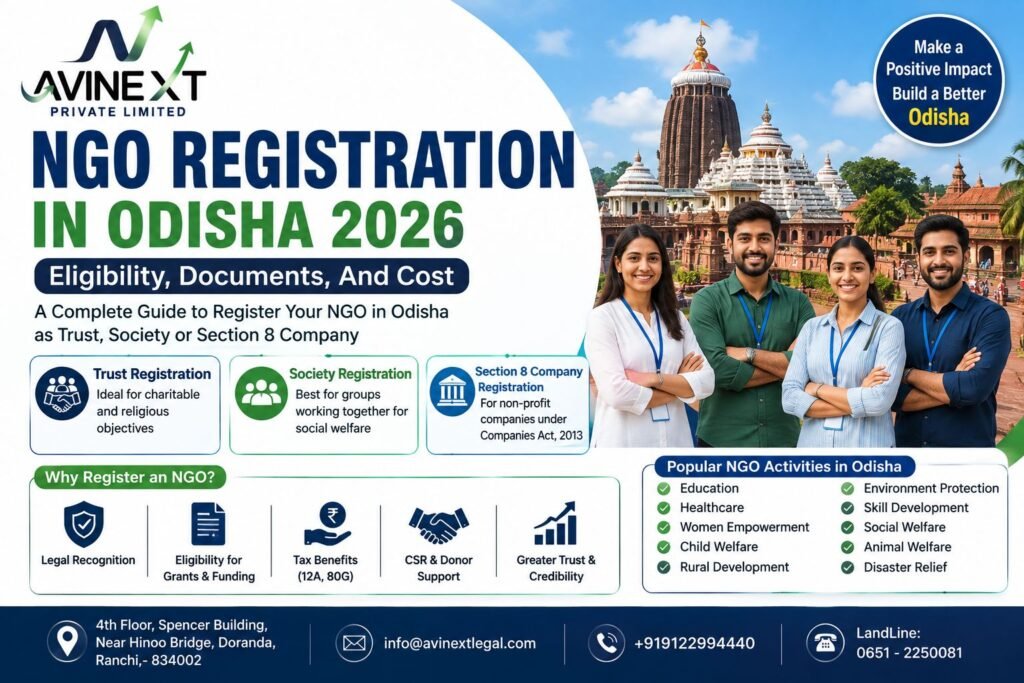
NGO Registration in Odisha 2026: Starting an NGO is not simply about obtaining a registration certificate. If you want to work seriously in areas such as education, healthcare, women empowerment, child welfare, rural development, environmental protection, skill development, social welfare or other charitable activities, choosing the right legal structure at the beginning can make a significant difference later.
If you are planning NGO Registration in Odisha in 2026, you can generally consider three common structures:
Trust | Society | Section 8 Company
Each structure has its own registration process, documentation, governance model and compliance requirements.
This guide explains NGO Registration in Odisha 2026, including eligibility, documents required, registration cost, process, Society registration, Trust registration, Section 8 Company registration and important post-registration requirements.
What is NGO Registration in Odisha?
NGO stands for Non-Governmental Organisation. An NGO is generally established to carry out charitable, social, educational, developmental or other non-profit activities. There is no single legal structure called an “NGO” that applies to every organisation. Depending on the nature and objectives of the organisation, an NGO may be established as:
1. Charitable Trust
A Trust is generally managed by trustees according to the terms and objectives contained in its Trust Deed.
2. Society
A Society is a membership-based organisation generally governed by a managing or governing body.
For Odisha, Society registration is handled under the applicable Society registration framework through the Inspector General of Registration, Odisha.
3. Section 8 Company
A Section 8 Company is incorporated under the Companies Act, 2013 and provides a more formal corporate structure for non-profit activities.
Choosing among these three structures should depend on your actual plans rather than simply selecting the cheapest registration.
Who Can Start an NGO in Odisha?
People from different professional and social backgrounds can come together to establish an NGO for legitimate non-profit objectives.
An NGO may be considered by:
- Social workers
- Teachers and education professionals
- Doctors and healthcare professionals
- Community groups
- Professionals
- Entrepreneurs interested in social initiatives
- Groups working for women and children
- Environmental activists
- Rural development groups
- Youth organisations
- Individuals interested in charitable activities
The founders should have a genuine non-profit objective and must comply with the legal requirements applicable to the selected structure.
Eligibility for NGO Registration in Odisha in 2026
There is no single eligibility test applicable to every Trust, Society and Section 8 Company.
Eligibility depends on the structure selected.
However, some basic considerations generally include:
Clear Non-Profit Objective
The organisation should have clearly defined charitable, social or other eligible non-profit objectives.
Eligible Founders or Members
The required number and type of founders will depend upon whether you are establishing a Trust, Society or Section 8 Company.
Registered Office
The organisation needs an appropriate registered-office address supported by the required documentation.
Proper Constitutional Documents
Depending upon the structure, the NGO needs a Trust Deed, Memorandum, Bye-laws, MOA/AOA or other applicable constitutional documents.
Lawful Activities
The proposed activities must comply with Indian law and any sector-specific regulations applicable to the work being undertaken.
What Activities Can an NGO Undertake in Odisha?
An NGO can be established for a wide range of legitimate charitable and social-development activities.
Popular NGO objectives include:
- Education
- Healthcare
- Women empowerment
- Child welfare
- Skill development
- Rural development
- Social welfare
- Poverty alleviation
- Environmental protection
- Animal welfare
- Tribal welfare
- Community development
- Senior citizen welfare
- Disability support
- Livelihood development
- Sports promotion
- Art and culture
- Research and awareness
- Disaster relief
- Public health awareness
- Water conservation
- Sanitation
- Digital literacy
The actual objects written in the NGO’s constitutional documents should reflect what the organisation genuinely plans to do.
Types of NGO Registration in Odisha
1. Trust Registration in Odisha
A charitable Trust is one of the structures commonly considered for charitable activities.
The Trust is normally governed according to a Trust Deed.
The Trust Deed is an important legal document because it generally defines:
- Name of the Trust
- Registered office
- Objectives
- Details of trustees
- Powers and duties of trustees
- Appointment and removal of trustees
- Management of funds
- Bank account operations
- Meetings
- Application of income and property
- Amendment provisions
- Other governance provisions
When Should You Consider a Trust?
A Trust may be considered where the founders prefer a trustee-based management structure.
It can be suitable for charitable initiatives relating to education, healthcare, relief, community development and other lawful public-benefit activities.
The applicable registration, stamp-duty and documentation requirements should be checked according to the nature of the Trust and current Odisha requirements.
2. Society Registration in Odisha
Society Registration is an important option for groups that want to operate through a membership and governing-body structure.
The official Inspector General of Registration, Odisha provides separate procedures for State-Level and District-Level Societies.
For a State-Level Society, the application goes to the Registrar of Society at IGR Odisha, Cuttack, followed by verification through the concerned administrative authorities.
For a District-Level Society, the application is submitted to the Additional Registrar of Society/ADM-cum-District Registrar of the concerned district, followed by field-level verification and scrutiny.
This distinction is particularly important when deciding the proposed operational area of the Society.
Documents Required for Society Registration in Odisha
According to the official Odisha IGR procedure, the documents for Society Registration include items such as:
- Application for Society Registration
- Memorandum of Society
- Bye-laws
- General Body resolution
- Notice and confirmation-related documents, where applicable
- Affidavit of President/Secretary
- House rent agreement
- Record of Rights (RoR) relating to the premises, as applicable
- Identity proof of members of the Governing Body
- Applicable fee/payment documentation
The official procedure requires the application and Memorandum to be signed as prescribed and specifies supporting registered-office and identity documents.
Applicants should prepare the documentation carefully because incomplete or inconsistent information can delay verification.
Society Registration Cost in Odisha 2026
According to the current fee-details page of the Inspector General of Registration, Odisha, the Society Registration fee is ₹1,000, along with a user fee of ₹250 for up to 10 pages and ₹15 for each additional page.
However, another official procedure page still displays an older ₹50 figure. Because of this inconsistency between government pages, applicants should verify the live fee on the IGR Odisha portal at the time of filing rather than relying solely on an older checklist.
Professional consultation, drafting, affidavits, documentation and other incidental expenses, if used, are separate from government fees.
How Long Does Society Registration Take in Odisha?
The Odisha IGR’s public-service timeline currently specifies:
District-Level Society Registration – 30 days
State-Level Society Registration – 90 days
These are official service-delivery timelines; actual processing can still depend on verification, completeness of documents and whether any clarification or correction is required.
This is why applicants should avoid advertisements promising unrealistic guaranteed registration timelines.
3. Section 8 Company Registration in Odisha
A Section 8 Company is incorporated under the Companies Act, 2013.
Unlike a Society, which is handled under the state registration system, Section 8 Company incorporation is administered through the Ministry of Corporate Affairs (MCA) framework.
A Section 8 Company may be formed for eligible non-profit objectives.
It is generally suitable for founders who prefer:
- Formal corporate governance
- Defined directors and members
- Corporate legal identity
- Structured record keeping
- Wider operational plans
- Institutional credibility
- More organised governance
A Section 8 Company also carries comparatively formal compliance responsibilities, so it should not automatically be selected merely because it appears more professional.
Trust vs Society vs Section 8 Company – Which is Better in Odisha?
There is no universally “best NGO registration.”
The best structure is the one that fits your objectives and future plans.
Trust
A Trust may be suitable when you want a trustee-based charitable structure.
Society
A Society may be suitable when several individuals want to work collectively through a membership and governing-body structure.
Section 8 Company
A Section 8 Company may be suitable where founders want a formal corporate governance framework and potentially broader institutional operations.
Before choosing, consider:
What activities will the NGO undertake?
How many people will manage it?
Will activities remain within one district, across Odisha or across India?
Does the organisation plan to seek institutional funding?
Will it approach companies for CSR projects?
What level of annual compliance can the organisation manage?
A proper answer to these questions usually makes the choice much clearer.
NGO Registration Process in Odisha 2026
Although the exact procedure changes according to the structure, the overall process can be understood in a few stages.
Step 1: Define Your NGO Objectives
Start by deciding exactly what your organisation intends to do.
Avoid copying a long list of objectives from another NGO merely to cover every possible activity.
Your objectives should be broad enough to support genuine future activities but specific enough to explain the organisation’s purpose.
Step 2: Choose the Legal Structure
Select:
Trust, Society or Section 8 Company
This decision affects governance, registration procedure and future compliance.
Step 3: Choose the NGO Name
Select a suitable and distinctive name.
The name should reflect the organisation’s purpose and comply with applicable naming requirements.
Availability and restrictions should be checked under the relevant registration system.
Step 4: Decide the Registered Office
Your NGO will require a registered-office address.
Depending on the structure and circumstances, you may need:
- Ownership documents
- Rent agreement
- NOC from owner
- Utility bill
- RoR/property-related document
- Other prescribed address proof
For Odisha Society Registration specifically, the official checklist includes registered-office-related documentation such as a house rent agreement and RoR as applicable.
Step 5: Draft Constitutional Documents
The documents depend on your structure.
Trust: Trust Deed
Society: Memorandum and Bye-laws/Rules & Regulations
Section 8 Company: MOA, AOA and prescribed incorporation documents
Drafting deserves careful attention because these documents define the organisation’s objectives, governance and powers.
Step 6: Submit the Registration Application
The application is submitted to the competent authority according to the selected structure. For Odisha Societies, the authority differs between district-level and state-level organisations. Section 8 Companies follow the MCA incorporation framework.
Step 7: Verification and Scrutiny
The competent authority examines the documents.
In the case of Odisha Society Registration, the official procedure specifically provides for field-level verification through authorities such as Tahasildars, BDOs, ULB Executive Officers, line-department officers or police officers, followed by scrutiny.
Step 8: Registration Certificate
If the application is found appropriate and approved, the registration certificate/incorporation documentation is issued. But registration should be viewed as the beginning of compliance, not the end.
Documents Required for NGO Registration in Odisha
Because Trusts, Societies and Section 8 Companies follow different procedures, there is no single document checklist applicable to all three.
Commonly required information may include:
- PAN of founders
- Aadhaar or other identity proof
- Address proof
- Photographs, where applicable
- Email ID
- Mobile number
- Proposed NGO name
- NGO objectives
- Registered-office proof
- Rent agreement, where applicable
- Owner’s NOC, where applicable
- Utility bill
- Details of trustees/members/directors
- Constitutional documents
- Resolutions
- Affidavits/declarations, where prescribed
Additional documents can be required depending on the structure and authority.
NGO Registration Cost in Odisha 2026
One of the most searched questions is:
“How much does NGO registration cost in Odisha?”
There is no single answer because the cost depends on whether you register a Trust, Society or Section 8 Company.
The overall cost may consist of:
- Government registration fee
- Stamp duty, where applicable
- User charges
- Digital Signature Certificate charges, where applicable
- Documentation expenses
- Affidavit/notarial expenses, where applicable
- Professional drafting or consultancy fee
- Additional registration expenses
For Societies, the current Odisha IGR fee page displays a ₹1,000 registration fee plus applicable user charges. For Trusts and Section 8 Companies, costs vary according to the applicable documentation, statutory framework and filing circumstances.
Therefore, any website advertising one universal “NGO Registration Cost in Odisha” should clearly explain what is included in that price.
NGO Registration in Bhubaneswar
If you are searching for NGO Registration in Bhubaneswar, the same basic choice applies:
Trust | Society | Section 8 Company
Your structure should be selected according to your objectives, number of founders, governance model and future plans. For a Society whose activities are confined to the relevant district, the district-level procedure may be relevant, while wider operations can affect the applicable registration route.
NGO Registration in Cuttack
Cuttack is particularly relevant to the Society registration system because the office of the Inspector General of Registration, Odisha is situated in Cuttack.
The official IGR Society procedure provides for State-Level Society applications through the Registrar of Society, IGR Odisha, Cuttack.
NGO Registration Across Odisha
NGOs may be established for activities across different parts of Odisha, including:
Bhubaneswar, Cuttack, Puri, Rourkela, Sambalpur, Berhampur, Balasore, Bhadrak, Baripada, Angul, Dhenkanal, Jajpur, Kendrapara, Jagatsinghpur, Khordha, Koraput, Rayagada, Keonjhar, Sundargarh, Mayurbhanj, Ganjam, Kalahandi, Balangir and other districts of Odisha.
The correct registration structure should depend on the organisation’s proposed operational area rather than merely its office location.
What to Do After NGO Registration?
After obtaining the basic registration, an NGO should evaluate its next legal and administrative requirements.
These may include:
- PAN
- Bank account
- NGO Darpan
- Applicable income-tax registration/approval
- Donation-related tax approval
- CSR registration, where eligible
- Accounting and bookkeeping
- Annual filings
- Audit, where applicable
- Statutory records
- FCRA registration/prior permission if foreign contributions are proposed
Not every NGO requires every registration immediately.
The correct compliance roadmap depends on what the organisation intends to do.
NGO Darpan Registration in Odisha
NPO Darpan is maintained by the Voluntary Action Cell of NITI Aayog.
Through the portal, eligible non-profit organisations can obtain a unique Darpan ID. NITI Aayog currently states that Darpan ID is mandatory for NPOs seeking grants from Ministries or Departments of the Government of India.
It also states that Darpan ID is required for FCRA registration/renewal and seeking exemption under 80G. NITI Aayog further notes that financial institutions have been mandated under the applicable PMLA record-maintenance framework to ensure NGO Darpan Unique ID for opening and operating NGO bank accounts.
This makes NGO Darpan an important post-registration consideration for organisations planning formal operations.
Is NGO Darpan the Same as NGO Registration?
No. This distinction is important. NGO Registration establishes the organisation under a legal structure such as a Trust, Society or Section 8 Company.
NGO Darpan provides the organisation with a Darpan ID for specified purposes.
Income-tax registration/approval deals with the NGO’s applicable tax treatment.
Donation-related approval deals with eligible tax deductions for donors.
CSR registration relates to eligibility as a CSR implementing agency where applicable.
FCRA registration/prior permission deals with foreign contribution.
These are separate legal or regulatory requirements.
Can an NGO Receive Government Grants in Odisha?
Registration alone does not guarantee any government grant.
Government funding schemes can have separate eligibility conditions relating to:
- Age of NGO
- Darpan ID
- Past activities
- Project experience
- Audited accounts
- Annual reports
- Beneficiary records
- Tax registrations
- Project proposals
- Scheme-specific eligibility
NITI Aayog specifically states that Darpan ID is mandatory for NPOs seeking grants from Central Government Ministries and Departments.
Therefore, anyone starting an NGO solely because they were promised an immediate government grant should first verify the relevant scheme and its eligibility criteria.
Can an NGO Receive CSR Funding?
An eligible NGO may potentially work as a CSR implementing agency, subject to the requirements of the Companies Act and applicable CSR Rules.
Basic NGO registration by itself does not guarantee CSR funding.
Organisations planning CSR projects should focus on:
- Legal registration
- Proper governance
- Tax compliance
- CSR eligibility
- Accounting
- Audit
- Project documentation
- Impact measurement
- Annual reports
- Transparency
Companies evaluating an NGO for CSR work generally need substantially more information than a registration certificate.
Can an NGO Receive Foreign Donations?
Foreign contribution is regulated separately under India’s FCRA framework.
A Trust, Society or Section 8 Company should not assume that ordinary NGO registration automatically allows foreign contributions.
The organisation should first determine whether FCRA registration or prior permission is required.
NITI Aayog currently states that Darpan ID is required for FCRA registration/renewal.
NGO Registration for Education in Odisha
An education NGO may work in areas such as:
- Literacy
- Educational support
- Scholarships
- Digital education
- Skill development
- Career guidance
- Libraries
- Learning centres
- Educational awareness
- Support for disadvantaged students
If the organisation plans to run regulated educational institutions, separate permissions may also apply. NGO registration alone should not be treated as an educational-institution licence.
NGO Registration for Women Empowerment
Women empowerment NGOs may undertake lawful activities relating to:
- Women’s education
- Skill training
- Entrepreneurship
- Livelihood development
- Financial literacy
- Legal awareness
- Community support
- Social awareness
- Leadership development
The constitutional objects should be drafted according to the activities genuinely proposed.
NGO Registration for Tribal and Rural Development in Odisha
Odisha has significant opportunities for genuine social-development work in rural and tribal communities.
An NGO may work on projects relating to:
- Rural education
- Livelihood development
- Skill training
- Health awareness
- Nutrition
- Water and sanitation
- Agriculture awareness
- Women empowerment
- Community development
- Digital literacy
Organisations working with vulnerable communities should maintain strong governance, financial transparency and proper beneficiary documentation.
NGO Registration for Healthcare Activities
Healthcare-focused NGOs may work on:
- Health awareness
- Medical camps
- Nutrition awareness
- Preventive healthcare
- Maternal and child health
- Community health programmes
- Health education
However, NGO registration itself does not replace licences or approvals required for regulated medical activities.
Common Mistakes While Registering an NGO in Odisha
Several problems can be avoided through better planning.
Selecting the Structure Only by Price
The cheapest registration is not necessarily the best structure for your organisation.
Poorly Drafted Objectives
Objects copied blindly from another NGO may not properly support your actual activities.
Incorrect Registered Office Documents
Address-related documentation should match applicable registration requirements.
Believing Registration Guarantees Funding
Registration does not automatically provide government grants, CSR funding or foreign donations.
Ignoring Compliance
An NGO continues to have legal and financial responsibilities after registration.
Mixing Personal and NGO Funds
The organisation’s financial transactions should be appropriately documented and separated from personal transactions.
Applying for Every Registration Immediately
Not every new NGO needs every available registration on day one. The compliance sequence should match the organisation’s actual requirements.
FAQs?
How can I register an NGO in Odisha?
First decide whether the organisation should be a Trust, Society or Section 8 Company. Prepare the applicable documents and submit the application through the relevant authority.
What are the main types of NGO registration in Odisha?
The commonly used structures are Trust, Society and Section 8 Company.
What is the cost of Society Registration in Odisha in 2026?
The current Odisha IGR fee-details page lists the Society Registration fee as ₹1,000, along with applicable user charges. Applicants should verify the live fee before filing because another official procedural page still displays an older figure.
How long does Society Registration take in Odisha?
The official public-service timeline currently lists 30 days for district-level Society Registration and 90 days for a State-Level Society.
Which is better: Trust or Society?
Neither is automatically better. The answer depends on your management structure, number of founders, activities and future plans.
Final Words
If you genuinely want to start an NGO in Odisha, focus first on building the right legal foundation. The process should ideally follow this order: Purpose → Founding Team → Legal Structure → Documentation → Registration → Bank & Tax Setup → Compliance → Activities → Funding
Do not choose between a Trust, Society and Section 8 Company merely on the basis of registration cost.
Also Read: