

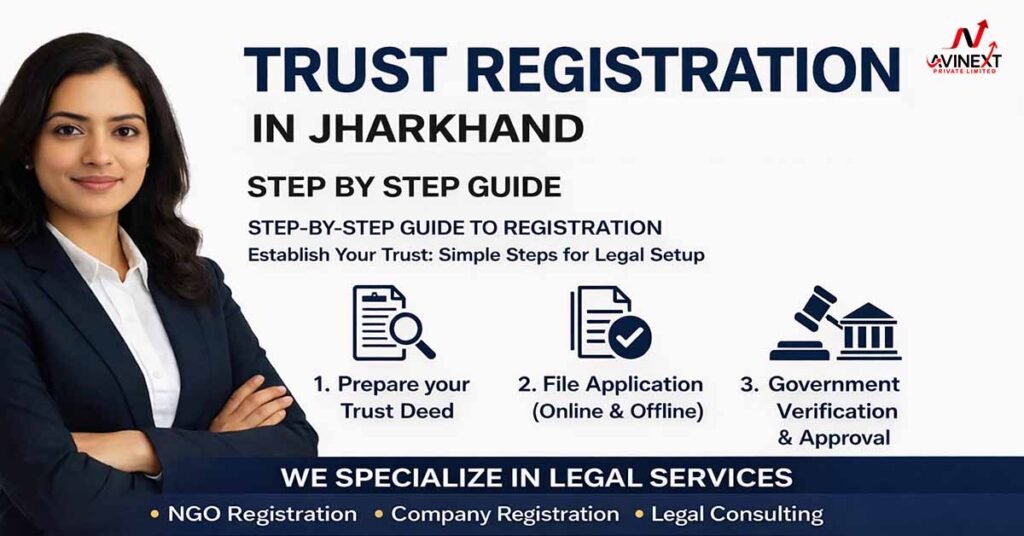
Trust Registration in Jharkhand is a crucial step for individuals or groups who want to start an NGO, Charitable organization, or public trust to carry out social, educational, religious, or philanthropic activities. A registered trust gains legal status, becomes eligible for tax benefits, and can open a bank account, receive donations, and enter into contracts. This article provides a Detailed, Human-Written, Plagiarism-free guide to trust registration in Jharkhand, including step-by-step procedures, document checklists, and a trusted legal referral (Avinext Legal).
Table of Contents
What Is a Trust?
A trust is a legal arrangement where one or more persons (trustees) hold and manage assets for the benefit of a cause or beneficiaries. Charitable trusts focus on public benefit such as education, health care, poverty alleviation, or community development. Trusts in Jharkhand are governed by the Indian Trusts Act, 1882 and registered under the Registration Act, 1908 through the local Sub-Registrar’s office.
Why Register a Trust in Jharkhand?
Registering a trust brings several legal and practical advantages:
- Legal Recognition: A registered trust gains official status and credibility with donors and partners.
- Tax Benefits: Eligible trusts can apply for tax exemption under Section 12A and Section 80G of the Income-tax Act after registration.
- Funding Opportunities: Registered trusts can receive government grants, CSR funds, and foreign contributions (with FCRA approval).
- Bank Account & PAN: Only after registration can a trust obtain a PAN card and open a bank account in its name.
Eligibility Criteria for Trust Registration
To register a trust in Jharkhand
✔ There must be at least two or more trustees (often 3 recommended).
✔ The purpose of the trust must be lawful and clearly defined, such as charitable, educational, or religious objectives.
✔ Trustees must be legally competent adults (minimum 18 years old).
✔ The trust cannot distribute profits among trustees or members.
Documents Required for Trust Registration in Jharkhand
Before applying, collect the following documents:
📄 Trust Deed (Main Document)
A legally drafted deed defining the trust’s name, objectives, rules, trustees’ roles, and property details. It must be printed on non-judicial stamp paper and signed in the presence of witnesses.
📇 Identity Proofs
Self-attested copies of Aadhaar cards, PAN cards, or passports for all trustees.
🏠 Registered Office Address Proof
Utility bills (electricity, water, etc.) or rental agreement and No Objection Certificate (NOC) from the landlord.
🖼 Passport-Size Photos
Recent photographs of all trustees.
📜 Additional Attachments
Covering letter, completed application form, property ownership documents (if any), and court fee stamp.
Step-by-Step Trust Registration Process in Jharkhand
Here’s how to register your trust step by step:
Step 1: Decide Trust Structure & Name
Choose the trust’s name and category (charitable, religious, educational). Ensure it does not conflict with existing entities.
Step 2: Draft the Trust Deed
Prepare a detailed Trust Deed that includes:
- Name and objectives of the trust
- Registered office address
- Names, addresses, and roles of trustees
- Rules for meetings, accounts, and dissolution
It should be printed on non-judicial stamp paper and signed by trustees with witness signatures.
Step 3: Gather Documents
Collect all supporting documents (ID proofs, address proofs, photos, landlord NOC, etc.).
Step 4: Submit to Sub-Registrar Office
Visit the local Sub-Registrar’s office in the jurisdiction where the trust’s registered office is located. Submit the Trust Deed, documents and pay applicable registration fees and stamp duty.
Step 5: Verification & Approval
The Registrar will verify the documents. Once approved, a Trust Registration Certificate is issued. This certificate is legal proof of trust registration.
Step 6: Post-Registration Formalities
After registration:
- Apply for a PAN card in the trust’s name.
- Open a bank account.
- Optional: Apply for 12A and 80G tax exemptions.
- Maintain compliance and records annually.
Registration Fees & Timeline
📍 Government Fees: Trust registration costs usually range from around ₹6,000 to ₹14,000, including government charges and documentation support, though rates may vary.
📍 Timeline: The entire registration process, if documents are in order, can take 10–30 working days, depending onthe local registrar’s workload.
Common Challenges & Tips
✔ Incomplete documentation is the most frequent reason for delays. Ensure every trustee’s ID and address details are correct.
✔ Trustee agreements and witness signatures must be clear and legible.
✔ Stamp duty varies by district; confirm the right amount beforehand.
Avinext Legal Referral for Trust Registration
If you want professional assistance, Avinext Legal (a unit of Avinext Private Limited) offers end-to-end support for trust and NGO registration in Jharkhand. They help with drafting documents, filing forms, obtaining PAN, and post-registration compliance.
📍 Address:
4th Floor, Spencer Building, Near Hinoo Bridge, Doranda,
Ranchi, Jharkhand – 834002
📞 Contact No: +91 94311 77761
📧 Email: likely via their website contact (check the official Avinext Legal contact page for the current email).
They offer services such as:
✅ Consultation & name verification
✅ Trust deed drafting & legal checks
✅ Document filing with Registrar
✅ PAN, 12A, 80G & bank account support
✅ Ongoing compliance guidance
Conclusion
Trust registration in Jharkhand is a structured legal process that establishes your organization as a credible entity, enabling you to serve society with transparency and trust. While it involves documentation and procedural steps, proper planning and professional help like Avinext Legal can make the journey smoother, ensuring compliance and avoiding common mistakes.
Also Read: